Our brain can heal itself – level 3

02-12-2025 15:00
Construction worker Phineas Gage survived a terrible accident in 1848 when an iron rod shot through his skull, destroying a large section of his right frontal lobe, the part of the brain associated with behavior and emotion.
Although he physically recovered, his personality drastically changed; the once reliable man became rude and capricious.
Friends famously claimed, ‘’Gage was no longer Gage.’’ However, his case provided the first insights into the brain’s flexibility, a concept now known as neuroplasticity. Gage later moved to Chile and worked as a stagecoach driver, a job that required significant cognitive effort, including memorization and steering multiple horses. This regular, repetitive activity served as self-directed neurorehabilitation. His recovery demonstrated that the adult brain is not fixed and can adapt by reallocating functions, a process called cortical remapping.
Gage’s survival and subsequent recovery changed the understanding of the brain, establishing him as a key figure in neuroscience and offering hope for recovery from brain injuries and mental health challenges today.
Difficult words: lobe (a rounded, often curved section that is part of a larger organ), stagecoach (a large, enclosed four-wheeled vehicle pulled by horses that was historically used to carry passengers and mail over long distances), subsequent (coming after something else in time or order).
You can watch the video news lower on this page.
Which concept, involving the brain’s flexibility and ability to adapt by reallocating functions, was first revealed by Gage’s injury and recovery?
LEARN 3000 WORDS with NEWS IN LEVELS
News in Levels is designed to teach you 3000 words in English. Please follow the instructions
below.
How to improve your English with News in Levels:

Test
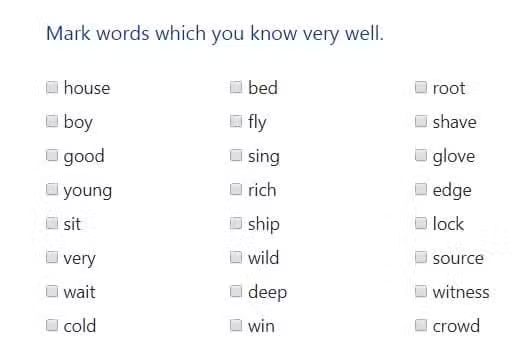
- Do the test at Test Languages.
- Go to your level. Go to Level 1 if you know 1-1000 words. Go to Level 2 if you know 1000-2000 words. Go to Level 3 if you know 2000-3000 words.

Reading
- Read two news articles every day.
- Read the news articles from the day before and check if you remember all new words.

Listening
- Listen to the news from today and read the text at the same time.
- Listen to the news from today without reading the text.

Writing
- Answer the question under today’s news and write the answer in the comments.

Speaking
- Choose one person from our Conversation section.
- Talk with this person. You can answer questions from Speak in Levels.
Stock images by Depositphotos